
Interactive Home Visits For 4th Year Medical Students
What did you do?
We have created an illustrated virtual home visit which allows fourth year medical students to ‘walk’ around the patient’s home and look at key areas with accompanying questions to allow for a standardised experience across a group of students.
Students complete this as a self-directed learning activity followed by a small group discussion in the next teaching session focusing on Frailty facilitated by a Tutor. The learning objectives have been mapped to the University and National assessment requirements. Students need to consider the factors impacting the patient and how they would address these.

Figure 1. Circle indicators highlight areas for students to review
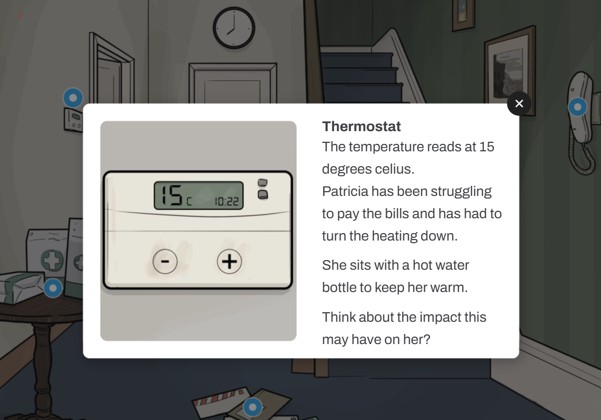
Figure 2. Prompting the students to critically reflect on areas highlighted
Why did you do it?
Home visits provide a unique learning experience. They allow a holistic assessment of a patient, helping provide contextual information about how a patient is coping with activities of daily life and aiding professionals to identify unmet needs of the patient[1]. There may be a variety of social and environmental factors which may impact patients with frailty. [2]
Home visits have been shown to help students to build skills and confidence[3]. However, we cannot guarantee that students will attend home visits whilst on their primary care placements as some surgeries work with home visiting teams, have low number of home visits and in those surgeries with frequent home visits the level of frailty will vary. Use of simulated or virtual home visits allow for a standardised experience across a group of students[4, 5]. Students prefer interactive and experiential learning methods[6].
Frailty is prevalent, and in 2020 it was estimated that 8.1% in adults in the UK over 50 years of age were frail[7]. Research has shown that healthcare professionals feel they require more training on frailty[8]. It has been suggested that teaching sessions on frailty should reflect the complexity of real-life cases[9]. With increasing frailty, patients are more likely to require home visits from primary care professionals and have an increased number of hospital admissions
The concept was developed alongside the Digital Education team as part of wider idea called the ‘Worsley Community.’ These are fictional patients' medical students will be introduced to over the years.
What was the impact?
A thematic analysis is currently being conducted of the data however the initial review of the questionnaires has shown an increase in the student confidence in recognising and managing frailty (see figure 3 and 4).
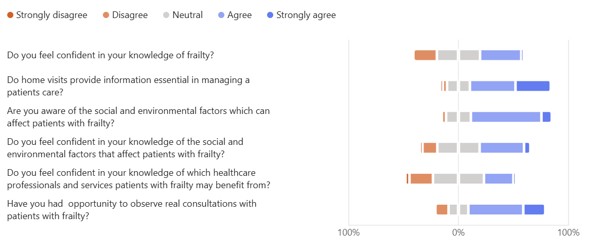
Figure 3. Pre teaching questionnaire

Figure 4. Post teaching questionnaire
How would it benefit others?
The basic concept of the resource can be applicable to other courses such as Nursing, Midwifery, Social work or Child and Family studies; where students are also likely to assess a client or patient holistically or complete home visits. It may help identify risk factors such as for safeguarding in a standardised and safe simulated environment. Given it creates a standardised resource, the concept lends itself to be used in assessment.
Final thoughts
We feel this is an innovative and sustainable method of engaging students and considering the impact of SDH on frailty. The session is also easily scalable and adapted to other subject areas.
Author
Dr Preetha Biyani
CCC co-lead
Academic Personal Tutor
Clinical Teaching Fellow
Academic Unit of Primary Care
Leeds Institute of Health Sciences
References
1. Unwin, B.K. and A.F. Jerant, The home visit. Am Fam Physician, 1999. 60(5): p. 1481-8.
- Sha, S., et al., Associations between loneliness and frailty among older adults: Evidence from the China Health and Retirement Longitudinal Study. BMC Geriatrics, 2022. 22(1): p. 537.
- Wright, D. and K. Ingram, MAKING IT REAL: SIMULATED HOME VISITS. 2013.
- Um, Y.-J., Nursing students’ simulated home-visit learning experiences with dementia -a qualitative research. BMC Nursing, 2023. 22(1): p. 70.
- Cockroft, M. and S. Oppewal, Beyond the Front Door: A Complex Home Visit Simulation. Nurse Educ, 2018. 43(2): p. 57-59.
- Nour, N., et al., Effectiveness of alternative approaches to integrating SDOH into medical education: a scoping review. BMC medical education, 2023. 23(1): p. 18-18.
- Sinclair, D.R., et al., Frailty among Older Adults and Its Distribution in England. J Frailty Aging, 2022. 11(2): p. 163-168.
- Avgerinou, C., et al., Perceptions, attitudes and training needs of primary healthcare professionals in identifying and managing frailty: a qualitative study. Eur Geriatr Med, 2021. 12(2): p. 321-332.
- Winter, R. and G.M.E. Pearson, Exploring the Challenges of Frailty in Medical Education. The Journal of Frailty & Aging, 2023. 12(2): p. 134-138.