
Decolonising
A decolonial education seeks;
- To question the origins of the knowledge taught and the colonial legacies that are replicated within.
- To challenge the presence of a hidden curriculum of assumed knowledge that unfairly disadvantages many.
- To ask whose knowledges and voices are undervalued and silenced.
- To work proactively to rebalance such unequal power dynamics.
- It is one where the evaluation of the curriculum and pedagogical practices is an evolving and responsive process and has partnership between the staff and student body at its heart.
- It aims to combat racial prejudices and discrimination and to challenge racialised privilege.
- It is relevant and applicable to all disciplines across the university.
- As well as addressing questions of curriculum and pedagogy, it also encompasses wider university structures and practices.
Decolonising Student Education Framework
There is no one way to decolonise, it requires us to continually reflect on and adapt our teaching. The UoL have a set of key principles that create a framework for reviewing our current practice and support for Student Education. The university is committed to embedding these principles in all taught student education provision. These principles, along with resources (reports, podcasts) and training and support, will help you decolonise your teaching.
If you are a University of Leeds student or staff member you can access the Decolonising Sharepoint to learn more about how to use and apply the framework in your practice.
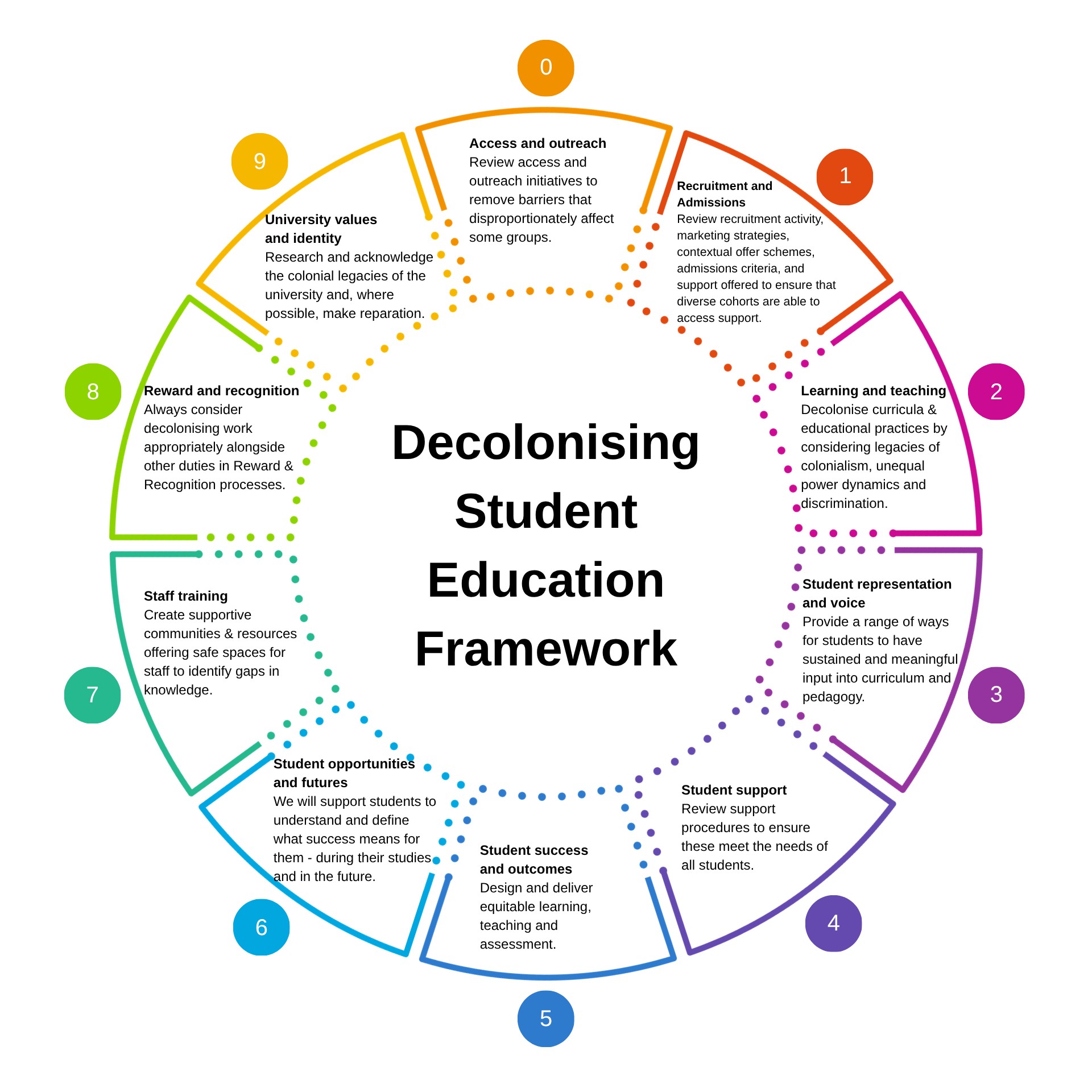
Decolonising Student Education Framework: Image full text description
0. Access and outreach: Review access and outreach initiatives to remove barriers that disproportionately affect some groups.
1. Recruitment and Admissions: Review recruitment activity, marketing strategies, contextual offer schemes, admissions criteria, and support offered to ensure that diverse cohorts are able to access support.
2. Learning and teaching: Decolonise curricula and educational practices by considering legacies of colonialism, unequal power dynamics and discrimination.
3. Student representation and voice: Provide a range of ways for students to have sustained and meaningful input into curriculum and pedagogy.
4. Student support: Review support procedures to ensure supports meet the needs of all students.
5. Student success and outcomes: Design and deliver equitable learning, teaching and assessment.
6. Student opportunities and futures: We will support students to understand and define what success means for them during their studies and in the future.
7. Staff training: Create supportive communities and resources offering safe spaces for staff to identify gaps in knowledge.
8. Reward and recognition: Always consider decolonising work appropriately alongside other duties in Reward & Recognition processes.
9. University values and identity: Research and acknowledge the colonial legacies of the university and, where possible, make reparation.
Resources
A set of resources, including reports and podcasts to help you decolonise your teaching.