
Student Perceptions of Immersive Learning Experiences
What did you do?
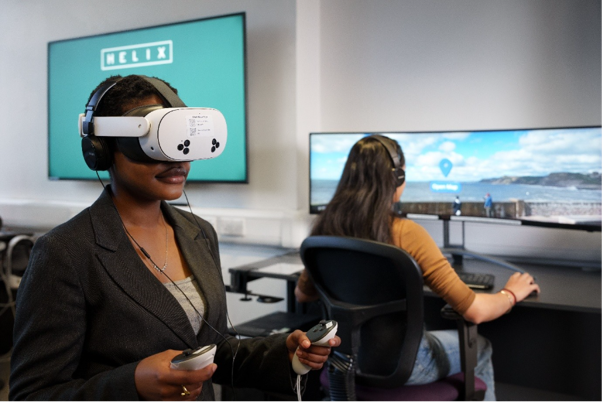
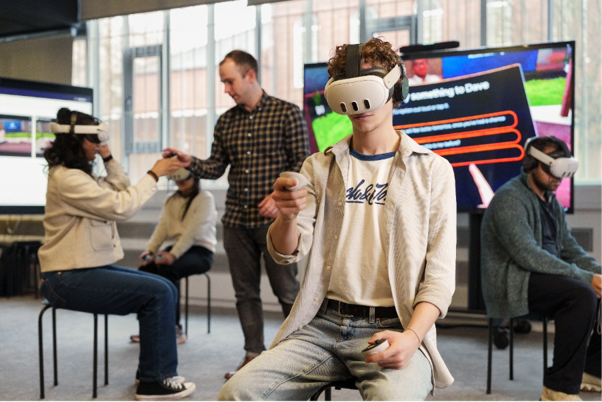
Last academic year (2025-26), 1,056 University of Leeds students participated in immersive learning activities facilitated by HELIX as part of their modules (Digital Education at the University of Leeds, 2026). While previous work at Leeds had explored staff perceptions of virtual reality (VR) in teaching (Jones, 2024), there had been little investigation into how students themselves perceived these experiences and whether they believed they supported learning.
As part of my PGCAP Module 3 project, I conducted a study to explore student perceptions of immersive learning experiences. The project aimed to understand whether students believed these experiences benefited their learning, what specific benefits they identified, and what factors appeared to influence those benefits.
The research used a survey informed by the Cognitive Affective Model of Immersive Learning (CAMIL) (Makransky and Petersen, 2021; Petersen et al., 2022) and the Unified Theory of Acceptance and Use of Technology (UTAUT) (Venkatesh et al., 2003; Walton et al., 2012; Venkatesh et al., 2016; Tamilmani et al., 2021; Shilling et al., 2025). Students were asked to confirm their module, faculty, what immersive learning experience they used, about their previous experience with VR, their perceptions of learning benefits, and their experiences using immersive learning activities. It mostly included Likert items, with free-text providing qualitative depth (Lewis and Munn, 1987; Croasmun, 2011; Chyung et al., 2017). Quantitative data was analysed using R (Crawley, 2015), alongside thematic analysis of free-text responses (Braun and Clarke, 2006). The full survey can be found here.
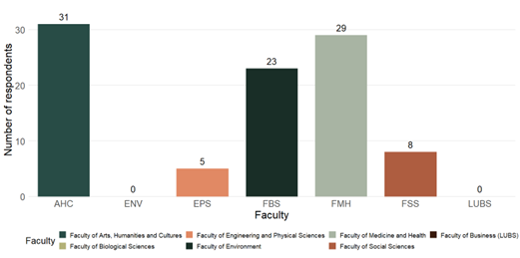
The study received ethical approval through the University of Leeds PGCAP Ethics Panel and collected responses from 96 students across multiple faculties, although the faculty proportions do not align with actual usage. Module leaders of students who had used immersive learning experiences facilitated dissemination of the survey during lectures or via Minerva announcements. Importantly, students completed the survey separately from the immersive learning activity itself, often some time afterwards, as the project formed part of a PGCAP study and recruitment was dependent on module-level dissemination opportunities. The findings therefore reflect retrospective student perceptions rather than immediate post-activity reactions, and are biased towards willing volunteers.
Why did you do it?
Much of the current support, training, and content design approaches for immersive learning at Leeds are based on established research suggesting that VR affordances such as presence and agency mediate learning in immersive environments (Makransky and Petersen, 2021). Getting started with VR in teaching training sessions delivered by HELIX and Digital Education Enhancement often discuss these ideas and their links to pedagogical approaches such as experiential learning and constructivist approaches (Kolb, 1984; Biggs, 2012). However, we had limited evidence about whether our students themselves experience these benefits in practice.
Understanding student perspectives is crucial to ensure that immersive learning activities are designed around educational value rather than technological novelty. The project therefore sought to capture student voice and generate evidence that could inform our future training and immersive learning design approaches, feed into ongoing evaluation of HELIX immersive activities, and assist current institutional strategy conversations relating to immersive learning.
What was the impact?
Several findings emerged from the study, which are already contributing to discussions around immersive learning strategy and are helping shape future approaches to staff support and experience design within HELIX.
Research question 1: How do prior experiences with immersive technologies impact the educational benefits of immersive learning experiences?
Prior educational experience with VR appeared to matter more than general familiarity with the technology. Students who had previously used VR in an educational context reported lower cognitive load (β = −1.28, p = 0.031), whereas general prior VR experience was not statistically significant (β = −0.58, p = 0.123). This suggests that pedagogical familiarity may help learners focus on learning tasks rather than the technology itself.
Research question 2: Did students perceive there to be an educational benefit to using an immersive learning experience?
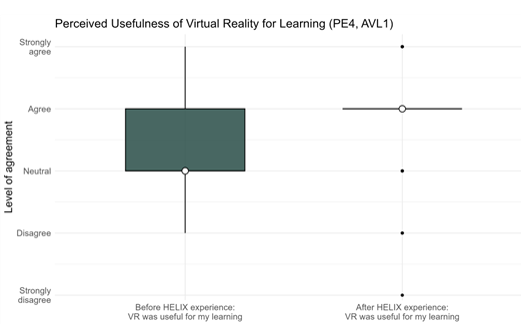
Students had increased belief in the learning value of immersive learning experiences after their usage. References to VR as a recreational technology disappeared from post-experience responses (13.5% pre to 0% post-use), while comments describing benefits such as improved engagement and the ability to visualise novel scenarios increased. At the same time, students became more aware of the limitations of immersive learning (2.1% to 10.4%), mentioning it “not being useful for everything”, or that in some situations “learning could have been achieved without VR”.
Research Question 3: What educational benefits did students attribute to their immersive learning experience?
Students reported positive perceptions across a range of learning outcomes, including knowledge improvement and retention, focus, psychological safety, enjoyment, and self-improvement.
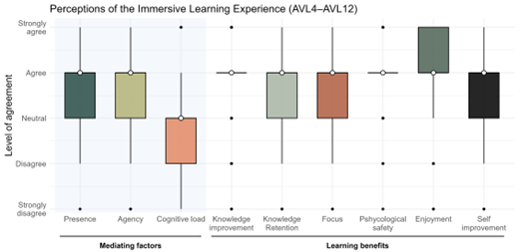
Spearman’s rank correlation analysis suggested that agency, the opportunity to actively make decisions and interact meaningfully within the experience, had the strongest association with these positive learning benefits (ρ ≈ 0.30 to 0.54, all p ≤ 0.003). Presence also demonstrated consistently positive associations with perceived learning benefits (ρ ≈ 0.29 to 0.45, all p ≤ 0.004). Interestingly, cognitive load did not have a statistically significant association.
How would it benefit others?
The project provides a useful example of how educational innovation can be evaluated through student voice. Rather than assuming that immersive technologies are beneficial at Leeds, the study gathered evidence directly from our learners to understand how and why they perceived value in their experiences.
For colleagues embedding immersive learning activities, the findings highlight the importance of designing for agency. Experiences that encourage active participation, real decision making and meaningful interaction are more likely to support positive learning outcomes than passive experiences. The findings also reinforce the value of aligning immersive activities with established pedagogical principles, such as constructivist approaches (Biggs, 2012), rather than focusing solely on the technology itself.
The study has also highlighted the importance of embedding evaluation into ongoing practice. Future plans include integrating a similar post-experience survey into the HELIX immersive learning workflow, enabled by a joint ethics application with the Centre for Immersive Technologies. This will enable more representative, larger-scale data collection and support a more robust understanding of the impact of immersive learning across the University.
The findings are based on delayed, retrospective self-reported perceptions gathered separately from the immersive learning activities themselves, which may be influenced by memory effects and response biases (Dang et al., 2020; Grimmond et al., 2025). Future evaluation will be immediately post-activity and should be complemented by evidence relating to measurable learning outcomes and in-platform metrics. However, this work provides an important first step towards understanding how students experience immersive learning and how we can design activities to maximise their educational value.
Author
Josh Gregg MRes, PGCAP, FHEA
Innovation Technologies Specialist
HELIX | Digital Education
References
Digital Education at the University of Leeds 2026. HELIX Impact Report 2026-26 [Online]. Leeds. [Accessed 27 May 2026]. Available from: https://digitaleducation.leeds.ac.uk/news/showcasing-success-helix-publishes-first-impact-report/.
Biggs, J. 2012. What the student does: Teaching for enhanced learning. Higher Education Research and Development. 31(1), pp.39–55.
Braun, V. and Clarke, V. 2006. Using thematic analysis in psychology. Qualitative Research in Psychology. 3(2), pp.77–101.
Chyung, S.Y.Y., Roberts, K., Swanson, I. and Hankinson, A. 2017. Evidence-Based Survey Design: The Use of a Midpoint on the Likert Scale. Performance Improvement. 56(10), pp.15–23.
Crawley, M.J. 2015. Statistics : an introduction using R Second edition. Chichester : John Wiley & Sons, Inc.
Croasmun, J.T. 2011. Using Likert-Type Scales in the Social Sciences. Journal of Adult Education. 40(1), pp.19–22.
Dang, J., King, K.M. and Inzlicht, M. 2020. Why Are Self-Report and Behavioral Measures Weakly Correlated? Trends in cognitive sciences. 24(4), pp.267–269.
Grimmond, J., Brown, S.D. and Hawkins, G.E. 2025. A solution to the pervasive problem of response bias in self-reports. Proceedings of the National Academy of Sciences - PNAS. 122(3), pp.e2412807122-.
Jones, G. 2024. Addressing Barriers to the Acceptance and Use of VR in Teaching [Online]. [Accessed 12 May 2026]. Available from: https://teachingexcellence.leeds.ac.uk/wp-content/uploads/sites/89/2024/12/2024-LITE-Fellowship-Snapshot-Gabriel-Jones.pdf.
Kolb, D.A. 1984. Experiential Learning: Experience As The Source Of Learning And Development [Online]. [Accessed 10 June 2026]. Available from: http://www.learningfromexperience.com/images/uploads/process-of-experiential-learning.pdf.
Lewis, Ian. and Munn, Pamela. 1987. So You Want To Do Research! A Guide for Teachers on How To Formulate Research Questions. The Scottish Council for Research in Education.
Makransky, G. and Petersen, G.B. 2021. The Cognitive Affective Model of Immersive Learning (CAMIL): a Theoretical Research-Based Model of Learning in Immersive Virtual Reality. Educational Psychology Review. 33(3), pp.937–958.
Petersen, G.B., Petkakis, G. and Makransky, G. 2022. A study of how immersion and interactivity drive VR learning. Computers and Education. 179.
Shilling, V., Starkings, R. and Fallowfield, L. 2025. Feasibility and acceptability of a virtual learning module for navigating angry conversations in clinical encounters. BMC Medical Education. 25(1).
Tamilmani, K., Rana, N.P. and Dwivedi, Y.K. 2021. Consumer Acceptance and Use of Information Technology: A Meta-Analytic Evaluation of UTAUT2. Information Systems Frontiers. 23(4), pp.987–1005.
Venkatesh, V., Morris, M.G., Davis, G.B. and Davis, F.D. 2003. User Acceptance of Information Technology: Toward a Unified View.
Venkatesh, V., Thong, J.Y.L. and Xu, X. 2016. Unified theory of acceptance and use of technology: A synthesis and the road ahead. Journal of the Association for Information Systems. 17(5), pp.328–376.
Walton, S.M., Thong, J.Y.L. and Xu, X. 2012. Consumer acceptance and use of information technology: extending the Unified Theory of Acceptance and Use of Technology. MIS Quarterly. 36, pp.157–178.