
University of Leeds Teaching Awards 2026 Winners
Explore the profiles of our award winners and discover more about the work, innovation and impact recognised in the 2026 University of Leeds Teaching Awards. For additional details about the awards, visit our main teaching awards page.
Early Career Excellence Winners
Dr Costas Loizou
SWJTU-Leeds Joint School, Faculty of Engineering and Physical Sciences
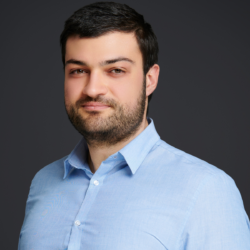 Dr Costas Loizou is a Lecturer in Mathematics at the SWJTU-Leeds Joint School, a transnational education (TNE) partnership between the University of Leeds and Southwest Jiaotong University, one of the University’s key strategic partners in China.
He joined the University as a Curriculum Redefined Transformative Educator in 2022 and is now Director of Year 1 for the Joint School. A Fellow of the Higher Education Academy (FHEA), Costas completed the Postgraduate Certificate in Academic Practice (PGCAP) and now supports colleagues as a mentor on the programme.
His work focuses on empowering TNE students to thrive in an English-medium instruction (EMI) curriculum by integrating problem-solving, disciplinary language development, and a strong sense of belonging to Leeds.
Costas has designed and leads core Year 1 modules for upcoming cohorts of more than 700 students and has extended this work to the Leeds International Summer School. To strengthen students' sense of belonging to Leeds, Costas incorporates a remote online experiment developed by colleagues from the Faculty of EPS, enabling China-based students to access physical equipment in Leeds remotely. His work on the interdisciplinary project The Yorkshire Engineering Map connects students with locations in Leeds using 360˚ images and interactive activities, while developing engineering vocabulary.
Underpinning his work is a commitment to making knowledge openly accessible. Costas leads The Academic Language of Mathematics, an open-access webbook co-created with students and colleagues across institutions and disciplines, supported by the Leeds Libraries Open Books Programme. Freely available to learners worldwide, the book equips students to communicate mathematical ideas confidently and clearly in English.
Extending beyond Leeds, Costas co-organised the international conference Language, Assessment & Disciplinary Specialism in UK-China TNE, through a British Council project via the Joint Institute Alliance. He has also co-organised the international workshop Making the Transition: Supporting Mathematicians Moving into Education Research and Pedagogical Scholarship, part of the IMA/RSS/LMS Higher Education Teaching and Learning Workshop Series 2025/26.
Costas is also a Fellow of the Leeds Institute for Teaching Excellence (LITE), working alongside colleagues to investigate ways of redesigning active learning pedagogies to recognise and value diverse modes of engagement, building on work into motivation and participation barriers in TNE.
Receiving this Early Career Teaching Award is a real affirmation that putting students at the centre genuinely makes a difference. It motivates me to deepen my values-led, evidence-informed approach to teaching, and to continue building and sharing openly across TNE and beyond. My students and colleagues remind me daily that everyone has something to teach us, and that is what keeps this work alive. I am deeply grateful to them for inspiring, shaping and supporting this work alongside me.
Dr Ashani Ranathunga
School of Civil Engineering, Faculty of Engineering and Physical Sciences
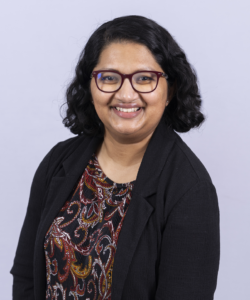 Dr Ashani Ranathunga is a Lecturer and Programme Leader for BEng/MEng Civil, Civil & Environmental, and Civil & Structural Engineering in the School of Civil Engineering. She completed her PhD in Geotechnical Engineering at Monash University, Australia, and joined Leeds in 2022 as a Curriculum Redefined Transformative Educator, following over four years of teaching at the University of Moratuwa, Sri Lanka. She became a Fellow of Advance HE in 2023 after completing the Postgraduate Certificate of Academic Practice (PGCAP).
Ashani’s teaching is driven by a deep commitment to inclusive, student-centred learning. Her transition to a teaching-focused role, shaped by reflective PGCAP practice, led her to critically rethink how students engage with complex engineering concepts. Recognising the challenges of uncertainty and cognitive overload, particularly for diverse, predominantly international cohorts, she redesigned her curriculum to prioritise clarity, structure, and accessibility.
This work resulted in two complementary frameworks: Flipped Micro-Modules (FMM) and Example-Based Learning with Multimedia (EBL-M). Together, they transform both content delivery and tutorial engagement, enabling self-paced learning alongside scaffolded, active participation. Their implementation has led to measurable improvements in student engagement, confidence, and attainment across multiple cohorts.
Central to Ashani’s practice is a co-participation model that repositions students as active contributors, alternating between co-learner and co-teacher roles. She extended this ethos to assessment through the Inclusive & Digitally Enhanced Assessment Support (IDEAS) framework, supporting inclusive, transparent, and digitally enhanced assessment practices at the programme level.
Her contributions to student partnership and support have been recognised through multiple nominations and faculty-level shortlisting for Academic Personal Tutor or Supervisor of the Year (2026).
As School Academic Lead for Inclusive Pedagogies (SALIP), she drives change beyond her classroom through initiatives such as the Inclusive Methods and Practices for Advancing Civil Engineering Teaching (IMPACT) Guide, which supports colleagues in embedding inclusive practice. Her current work promotes inclusive, media-enhanced learning and inclusive reflection methodologies, facilitating success for all learners.
Moments like winning the Leeds Teaching Award remind me that teaching is not just a path I chose, but one that has shaped who I am. Coming from an international background, I’ve always understood the challenges of adapting to new learning environments, which have shaped how I support and connect with my students. I feel incredibly privileged to work in a role where I learn alongside my students as much as I teach them. I would like to dedicate it to the students who trusted me and shared this journey, and to the wonderful colleagues who have supported me every step of the way.
Dr Carly O’Neill-Barrett
School of Sociology and Social Policy, Faculty of Social Sciences
 Dr Carly O’Neill-Barrett is a Lecturer in Sociology and Social Policy, the University’s Academic Lead for Authentic Assessment and Teaching Assistant Lead in the School of Sociology and Social Policy. She is a Senior Fellow of Advance HE and, from August 2026, will become the School of Sociology and Social Policy’s School Academic Lead for Inclusive Pedagogies. Her teaching and scholarship focus on creating meaningful, inclusive learning experiences that help students develop confidence and a critical view of the world, matched with the skills to change it.
A central theme of Carly’s work is assessment for learning. She is particularly interested in authentic assessment that connects academic learning with students’ personal and professional goals, disciplinary practice and wider society. Through University-wide workshops and the open education resource Authentic Assessment at Leeds: A Workbook, she supports colleagues to design assessment that is purposeful, inclusive and sustainable.
These principles are also evident in Carly’s own teaching. She redesigned her undergraduate dissertation research skills module, creating a more experiential approach that supports students to develop research questions, make methodological decisions, use feedback and navigate uncertainty. Her related scholarship explores how students develop and communicate their social and sociological voices through experiential learning.
Within her School, she recruits, trains and mentors teaching assistants and leads reflective teaching forums. Her work in this area was recognised with the Faculty of Social Sciences Partnership Award for Mentorship. Her aim is to help new educators become confident, thoughtful and inclusive practitioners, while creating a culture in which teaching can be discussed honestly and experienced as creative, collaborative and joyful.
Carly is also a certified LEGO® Serious Play® facilitator and uses creative, reflective methods in teaching, research and curriculum design.
I am genuinely thrilled to receive this award and proud to have my work recognised in this way. I have been very fortunate to learn from excellent mentors across the University and to work alongside generous and inspiring educators who are passionate about transforming higher education. Finding ‘my people’ here at Leeds has been a large part of what has enabled and inspired me to do the work recognised by this award.
Sustained Excellence Winners
Dr Pierre-Philippe Dechant
School of Mathematics, Faculty of Engineering and Physical Sciences
 Dr Pierre-Philippe Dechant is an Associate Professor in Mathematics at the School of Mathematics. He joined the University in 2022 as a Curriculum Redefined Transformative Educator.
After innovative programme design in his previous role, centred around skills development, reflective practice, work-based learning, communication, collaboration, interdisciplinary approaches and authentic assessments, including setting up a BSc Data Science Degree Apprenticeship, Pierre was excited to bring his experience to redefining programmes in the School of Mathematics, setting up a new BSc in Data Science, and contributing more broadly to the Faculty and University.
In his data science programme, Pierre works with a multiprofessional team to deliver an innovative course focused on active learning, skills development, reflection, collaboration, and communication. The programme combines a hackathon-style classroom format with diverse forms of assessments, including portfolios that encourage students to reflect on and articulate the skills they have developed. The skills impact data was analysed in collaboration with two summer students, and the findings were presented jointly at the Student Education Conference.
Working with dozens of colleagues and students, Pierre has led efforts in the School of Mathematics to embed sustainability across modules and to bring these together in an Open Textbook on the Leeds Pressbooks platform in collaboration with global partners. He has also led work on School student-staff partnership in collaboration with the Learning Design Team and has introduced novel approaches to teaching History of Mathematics, such as object-based learning, critical analysis and skills reflections.
Pierre is a passionate member of the University’s Sustainable Curriculum team, having set up the Leeds University Network for Sustainability in Higher Education (LUNSHE) three years ago and co-led it in a multiprofessional team. He has also contributed to making sustainability data sources available for student exploration in a Library Repository. More recently, Pierre has become LITE Incubator Lead for Sustainability and Community Engagement, supporting a community of practice in pedagogical research.
Pierre has championed active and experiential learning beyond the University, working with colleagues in Leeds and Southern Africa to run the annual hackathon ASA Datafest and Collaborative Online International Learning (COIL) sessions between student cohorts across three continents. He also established the pedagogical conference ‘COIL-Ed Spring’, next running at the University of Witwatersrand in October 2026. In recognition of his work, Pierre received an EPS Global Impact Award in May last year. The DATA Horizons Platform grant supports the expansion of this important work through additional partnerships in Southern Africa and their local communities.
Pierre is passionate about Public Engagement, having held leadership roles with Pint of Science in Yorkshire and the Humber and the North East for over 10 years. He has been an external examiner at Xi’an Jiaotong-Liverpool University for five years and is looking forward to taking up a similar role at the London Interdisciplinary School this autumn. A long-time Senior Fellow of the HEA, Pierre is keen to support his colleagues in the Leeds PRiSE scheme as a reviewer and mentor.
I am thrilled that this important work centred around student learning, sustainability and global partnerships has received this great honour. Collaborative and interdisciplinary work can be challenging, but it allows us to work together to effect meaningful impact on a much grander scale. That this award recognises this work is fantastic, and I would like to dedicate it to our wonderful students, colleagues, and global partners.
Dr Richard Harris
School of Psychology, Faculty of Medicine and Health
 Richard Harris, Associate Professor in the School of Psychology, has gained national and international recognition for his contributions to student education through innovative teaching, pedagogical research and educational leadership, research and educational leadership.
Richard’s student education practice and scholarship is underpinned by the concept of ‘psychological literacy’, an approach to teaching that enables students to understand psychology from diverse perspectives and apply their learning to real-world challenges. Through his pedagogical research, curriculum design, and teaching practice, he has emerged as a leading voice in advancing psychological literacy in Higher Education. For example, Richard has created modules that exemplify a student-centred approach, promoting cultural awareness and authentic engagement with social issues. His modules have received consistently high levels of student satisfaction and commendations from External Examiners.
As Director of Student Education, Richard has led a programme of educational transformation within the School of Psychology. He developed and implemented an education strategy focused on curriculum innovation, student support, and community building, resulting in a redesigned programme that foregrounds inclusion, diverse perspective, and the application of psychology to societal challenges.
Richard has led a range of initiatives that have enhanced students’ engagement, feedback, and community. Working in partnership with students, for example, Student Champion roles have been established, and community-building initiatives, such as the creation of a student kitchen and student writing retreats, have been introduced, strengthening the student experience across the School.
More broadly, Richard’s scholarship work has contributed to the development of the QAA's Hidden Curriculum guide, he has published pedagogical research on topics such as global citizenship and psychological literacy, and has chaired international teaching committees.
At the heart of everything I do is a commitment to providing students with an environment in which they can achieve their potential. I feel incredibly privileged to work with students and to play a small part in supporting them as they navigate their time at university and take their first steps beyond it. This award also reflects the generosity and support of colleagues who have helped develop many of the ideas recognised by this award. I am grateful to be part of a community that is committed to making a positive difference to students.
Dr Salma Al Arefi
School of Electronic and Electrical Engineering, Faculty of Engineering and Physical Sciences
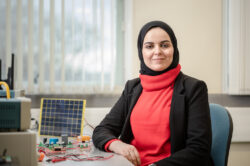 Dr Salma Al Arefi is Deputy Director for Student Education (Student Success) and Academic Lead for Inclusive Pedagogical Practice in the School of Electronic and Electrical Engineering. Her work centres on advancing inclusive pedagogical practice in engineering education through inclusive assessment, curriculum enhancement, educator development, and evidence-informed approaches that improve student success and the wider student experience.
Working at the intersection of engineering education, inclusion, and educational leadership, Dr Al Arefi has led the development of institutional frameworks and professional development that embed inclusive-by-design approaches within assessment across the University. Her work has informed institutional practice and continues to strengthen inclusive assessment as a core component of student success.
Dr Al Arefi's work on inclusive assessment has attracted national attention through a Quality Assurance Agency (QAA) Collaborative Enhancement Project, bringing together UK higher education institutions to evaluate and refine an evidence-informed framework for inclusive assessment across diverse disciplinary contexts. Through this collaboration, she is leading the development of sector-wide approaches that support more equitable assessment design, with the aim of enhancing educational practice, and improving student outcomes.
Alongside her institutional leadership, Dr Al Arefi contributes to national and international initiatives in engineering education, inclusive pedagogy, and the responsible use of artificial intelligence in higher education. She is particularly passionate about supporting the attraction, participation, and retention of underrepresented groups in engineering through inclusive educational practice.
I am deeply honoured to receive this recognition. One of the greatest privileges of being an educator is the opportunity to learn from students. Their experiences have continually reminded me that inclusion is not an initiative but a responsibility, and that meaningful improvements do not always require fundamental redesign. Often, thoughtful and intentional changes can make a profound difference to students' learning, experience and success. I hope this recognition encourages continued conversations about inclusive teaching practice.
Early-Stage Collaborative Excellence Winners
Team LEGO Serious Play
Team consists of Sarah Briggs (Digital Education), Dr Carly O’Neill-Barrett (School of Sociology and Social Policy), Dr Dan Trowsdale (School of Mechanical Engineering), Sean Gledhill (Digital Education), and Dr Katie Carpenter (School of History).

L to R: Sean Gledhill, Dr Carly O’Neill-Barrett, Dr Katie Carpenter, Sarah Briggs and Dr Dan Trowsdale
Team LEGO Serious Play brings together five educators from across the University. The team shares a commitment to creative, inclusive and participatory approaches to improving student education. The collaboration centres on LEGO Serious Play (LSP), a facilitated method in which participants build models and use metaphor to express ideas, experiences and perspectives. The method makes thinking visible and tangible, helping people engage with complexity, reflect deeply and create shared understanding. Its structured approach is inclusive of a wide range of needs and ensures that everyone contributes and is heard.
The team applies the method to improve student education at three connected levels.
First, members use LSP within their own education practice. Across disciplines and contexts, they use it to support research, employability, induction, curriculum design and student partnership. The method creates space for creativity, structured reflection, non-linear narrative and argument building, and lived experience alongside more conventional academic ways of knowing.
Second, the team supports colleagues by designing and facilitating sessions in which they can improve student education in their own contexts. These sessions have supported work across every faculty at Leeds, including curriculum and assessment design, interdisciplinary collaboration, digital education and professional development. Rather than arriving with predetermined answers, the team creates conditions in which participants can make sense of challenges and develop responses suited to their students and settings.
Third, the team teaches others to use the method themselves. Sarah is an accredited trainer and is training colleagues across the institution. These colleagues are now applying LSP in their own teaching and using it to support the practice of others. The team is building sustainable capacity for more creative, participatory and inclusive approaches to student education.
This growing impact is enabled by the collaboration itself. Team LSP has developed a supportive community of practice in which members share opportunities and expertise, co-design sessions and act as critical friends. They give one another confidence to experiment and take risks while preserving the integrity and quality of the method. Together, they have achieved more than any member could have achieved alone. Their work has established Leeds as a leading centre for LSP in higher education, with a growing national and international reach.
Team members:
- Sarah Briggs is a Faculty Digital Education Manager for the Faculty of AHC and the Lifelong Learning Centre, a learning designer, and a certified LSP trainer. She has used LSP to support curriculum design, collaborative educational problem-solving, team development and organisational change. Sarah leads the accredited LSP facilitator training programme at Leeds.
- Dr Carly O’Neill-Barrett is a Lecturer in Sociology and Social Policy and the University’s Academic Lead for Authentic Assessment. She uses LSP in curriculum design and pedagogic research. She has recently applied the method in a pedagogical research project on the student experience of experiential learning.
- Dr Dan Trowsdale is an Associate Professor in the School of Mechanical Engineering. He initially implemented LSP as part of a LITE project on curriculum co-design with students in 2019. He has facilitated numerous teaching and research focussed LSP workshops in the UK, China, Mexico and Germany.
- Dr Katie Carpenter is an Associate Professor in the School of History. She uses LSP to create inclusive, participatory spaces in which students and colleagues can explore ideas, challenge assumptions and shape educational practice together. Her work with the method spans student partnership, curriculum and assessment design, and pedagogic research.
- Sean Gledhill is Faculty Digital Education Manager for the Faculty of Biological Sciences and the Faculty of Medicine and Health. Since becoming a certified LSP facilitator in 2023, he has used the method to create engaging, inclusive learning experiences for large student cohorts. His workshops support students to build connections, navigate groupwork and explore their developing professional identities through activities focused on welcome and induction, employability and collaboration.
We are proud of what we have achieved, and even more proud that we achieved it together. We have given one another the confidence to grow, experiment and take risks, while bringing a spirit of play, creativity and generosity to our work. This award feels like a celebration of the power of that collaboration.
SOUL Modules – Learning Beyond the Classroom
Team consists of Dr Vivienne Griggs (Lifelong Learning Centre), Dr Simon Glaze (Lifelong Learning Centre), Victoria Turner (Transformation Office), Harry Short (Transformation Office), Dr Rosalyn Cousins (Digital Education), Eve Donlon (Student Education and Experience), Tracey Gallagher (Student Education and Experience), and Abby Abbott (Communications).

L to R: Dr Vivienne Griggs, Dr Simon Glaze, Tracey Gallagher, Harry Short, Dr Rosalyn Cousins, Eve Donlon. Team members not pictured: Victoria Turner and Abby Abbott.
The SOUL Project Team is an interdisciplinary collaboration bringing together colleagues from the Lifelong Learning Centre, Digital Education Enhancement, Student Education and Experience, Communications and the Curriculum Redefined programme. Together, the team developed and launched the SOUL (Structured, Open, Unbounded, Learner-led) modules, creating a new University-wide category of Discovery modules that enables students to gain academic credit through experiential learning.
SOUL modules give students the chance to gain real-world experience alongside their degree, developing valuable professional skills through a wide range of authentic activities and projects. Designed to recognise the value of learning beyond the classroom, SOUL provides opportunities for students to connect experiential learning with academic study through a flexible and inclusive learning framework. In its first year, the initiative attracted over 100 students from approximately 60 degree programmes and became one of the University's most selected Discovery module options. Students reported increased confidence, enhanced employability skills and a greater appreciation of learning through real-world experiences, while external partners praised the professionalism and quality of students' work.
Meet the team:
- Dr Vivienne Griggs is Associate Director of the Lifelong Learning Centre. Her research interests focus on learning theory, higher education and how educators facilitate effective learning. Her work on SOUL builds on longstanding interests in experiential learning and recognising learning that takes place across a range of educational contexts.
- Dr Simon Glaze is a Lecturer in Teaching and Scholarship (Portfolio Development) in the Lifelong Learning Centre. He has extensive experience in work-integrated learning and widening access to higher education for learners from non-traditional backgrounds.
- Victoria Turner is a Project Manager in the Transformation Office working on the Curriculum Redefined programme. She has successfully delivered several projects at the University and played a key role in supporting SOUL from its initial development and approval through to implementation.
- Harry Short is a Programme Management Office Analyst in the Transformation Office. Working alongside project managers to provide assurance and support for project delivery, he has contributed to the Curriculum Redefined programme since joining the University in 2024.
- Dr Rosalyn Cousins is Senior Learning Technologist for the Lifelong Learning Centre within Digital Education Enhancement. She is passionate about creating inclusive and engaging learning experiences and has extensive experience in digital learning design and higher education teaching.
- Eve Donlon and Tracey Gallagher are members of the Student Education and Experience team. They played a central role in translating the SOUL concept into operational reality, helping to establish the processes, systems and student-facing support required for successful delivery.
- Abby Abbott led communications activity for the project, supporting engagement with stakeholders across the University and helping build awareness and understanding of SOUL among staff and students.
We are delighted that the University gave us the opportunity to develop this innovative suite of modules. SOUL recognises that valuable learning takes place in many different ways during a student's time at university and acknowledges the importance of learning beyond the classroom. The fantastic feedback from students in the first year has aligned strongly with our original aims and has demonstrated the value of this approach. Receiving this award is wonderful recognition of the collaborative effort that made SOUL possible. We are excited to continue developing the modules, expanding the opportunities available and working more closely with Leeds University Union and academic partners to broaden the range of experiences on offer to students.
Sustained Collaborative Excellence Winners
Year 5 MBCHB TEAM – Achieving excellence through collaboration
Team consists of Dr Christopher Mannion (Consultant Maxillofacial Surgeon), Dr Dariush Saeedi (GP), Dr Joanna Wright (Consultant Neonatal Medicine), Dr Louise Gazeley (GP), Zoë Shepherd-Scott (Lead Yr 5 Administration) – School of Medicine and the Leeds Institute of Medical Education (LIME)
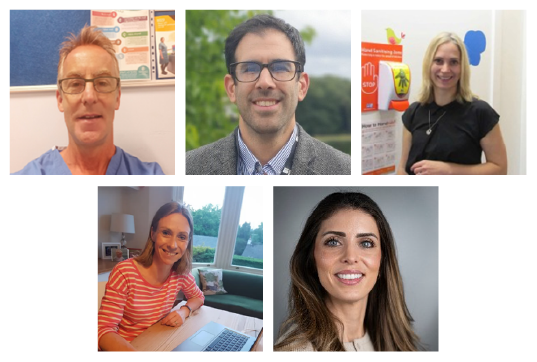
L to R: Dr Christopher Mannion, Dr Dariush Saeedi, Dr Joanne Wright, Dr Louise Gazeley and Zoë Shepherd-Scott.
As co-leads/heads for the MBChB Year 5 (Final Year), the team comprises of three colleagues (or co-heads of year), an academic sub‑dean (ASD), and a primary administrator, all working collaboratively and collectively to deliver a complex and high‑stakes programme.
All three co-heads are practising NHS clinicians (Consultant Surgeon, Consultant Neonatologist, and General Practitioner) and work closely in tandem with the team’s administrative lead, Zoë Shepherd-Scott, and ASD Dr Louise Gazeley (also a practicing GP). Balancing these clinical roles with educational responsibilities requires a highly coordinated, flexible, and trusting team approach, but allows the team to maintain an authentic and ‘real-world view’ for student colleagues, who are soon to transition into frontline NHS foundation doctors. The team has been built grounded in shared purpose, professional respect, and open communication.
Their collective goal is to ensure every student successfully completes the final year of the MBChB and is fully prepared for safe, effective practice as a newly qualified doctor. The final-year course aligns with the requirements of the General Medical Council’s Outcomes for Graduates, which focuses on clinical competence, professional behaviours, applied medical knowledge, and readiness for transition into the Foundation Programme. The team draw on their diverse clinical expertise to design, deliver, and quality‑assure teaching, hospital and GP/clinical placements, assessments, and pastoral support, ensuring these shared goals remain central to all decisions and in the best interests for their students.
Working together, each member of the team contributes deeply from their professional background while ensuring the programme functions seamlessly. Their collective reflection and shared responsibility ensure that decisions are informed by the full breadth of clinical and educational expertise within the team.
The final-year course is challenging for student colleagues, undertaking several major assessments, including the Medical Licensing Assessment Applied Knowledge Test, the Clinical and Professional Skills Assessment, and the Prescribing Safety Assessment. These assessments require meticulous, team‑based planning. The team’s shared NHS clinical experience enhances the authenticity, relevance, and professional standards of the curriculum and assessments, providing strong role modelling for students preparing for real‑world practice.
The team emphasise throughout the year the transition to clinical practice, integrate support in career development, and maintain strong involvement through near‑peer contributors (i.e. recent Leeds graduates) to enrich learning, relevance, and support. Their shared ethos is that the final-year student colleagues should feel known, supported, and professionally prepared. The team demonstrate a dynamic and innovative approach, using digital tools to collate feedback and communicate changes and improvements quickly and effectively. They have also developed their own social media and podcast channel to develop individual professional identity and ease the transition from student to doctor – an idea that has since been adopted nationally by the Medical Schools Council!
Ultimately, the team embodies the principle that “there is no ‘I’ in team.” They work and function with collective purpose, shared responsibilities, and a commitment to continuous improvement. This collaboration ensures that their student colleagues receive the highest quality of education, assessment, and support during the most important year of their medical training.
This award is fantastic! We are immensely proud to work with our student colleagues, seeing them flourish into the next generation of capable and compassionate doctors. Our aim, in the final year, has always been to inspire, educate and prepare them for their future professional lives and careers – and we are privileged to play an important part in their journey.